Introduction
Artificial Intelligence (AI) has evolved from a futuristic concept into one of the most transformative technologies of the 21st century. Today, AI powers everything from virtual assistants and recommendation systems to autonomous vehicles and advanced medical diagnostics. Businesses across the globe are embracing AI to improve efficiency, reduce costs, enhance customer experiences, and gain a competitive edge.
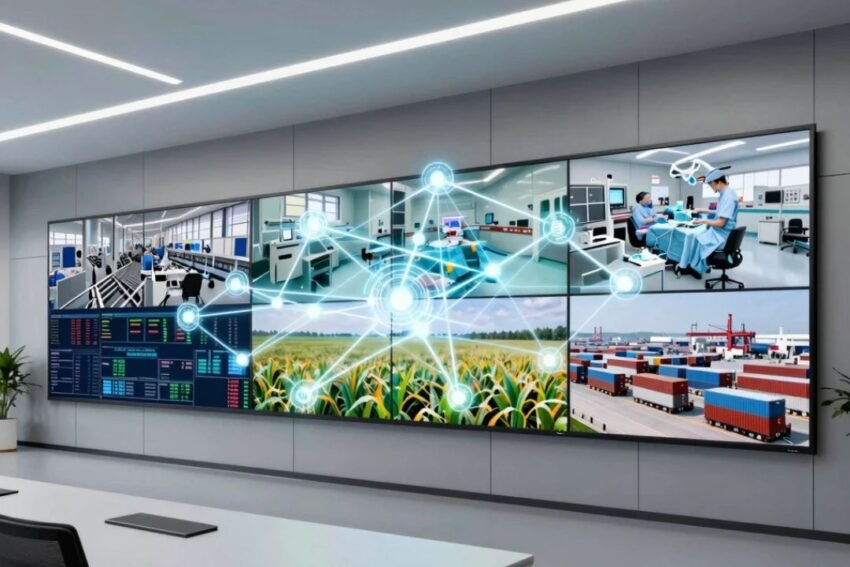
As organizations continue their digital transformation journeys, Artificial Intelligence is becoming a critical driver of innovation. Whether it’s healthcare, finance, manufacturing, education, retail, or agriculture, AI is reshaping traditional business models and creating new opportunities for growth.
In this article, we’ll explore how Artificial Intelligence is revolutionizing every major industry, the technologies behind its success, its benefits, challenges, and what the future holds for AI-driven industries.
What Is Artificial Intelligence?
Artificial Intelligence refers to computer systems designed to perform tasks that typically require human intelligence. These tasks include learning from data, recognizing patterns, understanding natural language, solving problems, making decisions, and generating content.
Modern AI combines several technologies, including:
- Machine Learning (ML)
- Deep Learning
- Natural Language Processing (NLP)
- Computer Vision
- Robotics
- Predictive Analytics
- Generative AI
Together, these technologies enable businesses to automate processes, analyze massive datasets, and make smarter decisions faster than ever before.
Why Artificial Intelligence Is Transforming Industries
Businesses generate enormous amounts of data every day. AI can analyze this data in real time, uncover valuable insights, automate repetitive tasks, and predict future trends.
The main reasons industries are investing in AI include:
- Increased operational efficiency
- Reduced business costs
- Improved customer satisfaction
- Faster decision-making
- Better risk management
- Enhanced productivity
- Personalized services
- Continuous innovation
These advantages make AI one of the most valuable technologies in today’s business landscape.
Artificial Intelligence in Healthcare
Healthcare has experienced one of the biggest transformations through Artificial Intelligence.
AI-powered systems assist doctors by analyzing medical images, detecting diseases earlier, and recommending personalized treatment plans. Hospitals use AI to optimize patient scheduling, monitor vital signs remotely, and improve administrative workflows.
Key Applications
- Medical imaging analysis
- Disease prediction
- Drug discovery
- Virtual health assistants
- Robotic surgery
- Personalized medicine
- Remote patient monitoring
Benefits
- Faster diagnosis
- Improved patient care
- Reduced medical errors
- Lower healthcare costs
- Better treatment outcomes
AI allows healthcare professionals to spend more time focusing on patient care while automating routine administrative tasks.
Artificial Intelligence in Finance
The financial industry has rapidly adopted AI to improve security, automate processes, and deliver personalized financial services.
Banks and financial institutions use AI to detect fraudulent transactions, assess credit risk, analyze investments, and provide intelligent customer support through AI-powered chatbots.
Common Applications
- Fraud detection
- Credit scoring
- Algorithmic trading
- Financial forecasting
- Loan approvals
- Customer service automation
- Risk management
Benefits
- Improved accuracy
- Enhanced security
- Faster transactions
- Better investment decisions
- Reduced operational costs
AI enables financial institutions to provide safer and more efficient services to customers.
Artificial Intelligence in Manufacturing
Manufacturing companies use AI to automate production, improve product quality, and optimize supply chains.
Smart factories rely on AI-powered robots, predictive maintenance systems, and real-time analytics to maximize efficiency.
AI Applications
- Industrial automation
- Predictive maintenance
- Quality inspection
- Inventory optimization
- Supply chain management
- Warehouse automation
Benefits
- Reduced downtime
- Higher productivity
- Lower maintenance costs
- Improved product quality
- Faster production cycles
AI-driven manufacturing creates more reliable and cost-effective production environments.
Artificial Intelligence in Retail and E-Commerce
Retail businesses use AI to personalize shopping experiences and streamline operations.
Online stores analyze customer behavior to recommend products, optimize pricing, and improve inventory management.
AI in Retail
- Product recommendations
- Customer behavior analysis
- Inventory forecasting
- Smart pricing
- AI chatbots
- Visual product search
- Personalized marketing
Benefits
- Increased sales
- Better customer experiences
- Improved inventory management
- Higher customer retention
- Faster customer support
AI helps retailers understand customer preferences and deliver more relevant shopping experiences.
Artificial Intelligence in Education
Education is becoming more personalized thanks to Artificial Intelligence.
AI-powered learning platforms adapt lessons based on each student’s progress and learning style.
Applications
- Intelligent tutoring systems
- Automated grading
- Personalized learning
- Language translation
- Virtual classrooms
- Student performance analysis
Benefits
- Individualized education
- Faster feedback
- Improved learning outcomes
- Reduced administrative work
- Increased student engagement
Teachers can focus more on mentoring while AI handles repetitive administrative tasks.
Artificial Intelligence in Transportation
Transportation is undergoing significant changes with AI-powered technologies.
AI improves traffic management, vehicle safety, logistics, and route optimization.
AI Applications
- Autonomous vehicles
- Fleet management
- Predictive maintenance
- Traffic monitoring
- Route planning
- Delivery optimization
Benefits
- Reduced fuel consumption
- Improved road safety
- Faster deliveries
- Lower transportation costs
- Better traffic flow
AI is making transportation systems smarter, safer, and more efficient.
Artificial Intelligence in Agriculture
Agriculture has embraced AI to increase productivity while reducing environmental impact.
Farmers use AI-powered tools to monitor crops, predict weather conditions, and optimize irrigation.
Applications
- Precision farming
- Crop monitoring
- Pest detection
- Soil analysis
- Smart irrigation
- Harvest prediction
Benefits
- Higher crop yields
- Reduced water usage
- Lower farming costs
- Better resource management
- Sustainable agriculture
AI enables farmers to make data-driven decisions that improve efficiency and food production.
Artificial Intelligence in Entertainment and Media
The entertainment industry relies heavily on AI to create personalized experiences.
Streaming platforms recommend movies, music, and shows based on user preferences, while content creators use AI to generate images, videos, scripts, and music.
Applications
- Content recommendations
- Video editing
- AI-generated music
- Personalized advertising
- Gaming AI
- Content moderation
Benefits
- Improved user engagement
- Personalized experiences
- Faster content production
- Enhanced creativity
- Better audience targeting
AI is transforming how people consume and create digital entertainment.
Artificial Intelligence in Customer Service
Customer service has improved dramatically with AI-powered virtual assistants and chatbots.
Modern AI systems can answer questions, resolve issues, process orders, and provide 24/7 support.
Applications
- AI chatbots
- Virtual assistants
- Email automation
- Customer sentiment analysis
- Voice assistants
Benefits
- Faster response times
- Lower support costs
- Increased customer satisfaction
- Round-the-clock availability
- Improved service quality
Businesses can serve more customers while maintaining consistent support.
Artificial Intelligence in Cybersecurity
As cyber threats become more advanced, AI plays a crucial role in protecting digital systems.
AI continuously monitors networks to identify suspicious activities and respond to threats in real time.
Applications
- Threat detection
- Malware analysis
- Fraud prevention
- Identity verification
- Network monitoring
Benefits
- Faster threat detection
- Improved security
- Reduced data breaches
- Automated incident response
- Stronger data protection
AI strengthens cybersecurity by detecting risks before they become major problems.
Benefits of Artificial Intelligence Across Industries
Artificial Intelligence provides numerous advantages regardless of industry.
Some of the biggest benefits include:
- Increased productivity
- Business automation
- Reduced operational costs
- Improved decision-making
- Better customer experiences
- Enhanced data analysis
- Greater accuracy
- Scalable business operations
- Continuous innovation
- Competitive advantage
Organizations adopting AI can operate more efficiently while delivering higher-quality products and services.
Challenges of AI Adoption
Despite its many advantages, implementing AI also presents several challenges.
Data Privacy
Organizations must protect customer data and comply with privacy regulations.
High Initial Investment
Developing AI systems often requires significant investments in technology, infrastructure, and skilled professionals.
Skills Gap
Many businesses struggle to find AI experts, data scientists, and machine learning engineers.
Ethical Concerns
AI systems must be transparent, fair, and free from bias to ensure responsible use.
Cybersecurity Risks
As AI systems become more connected, protecting them from cyberattacks becomes increasingly important.
Addressing these challenges is essential for successful AI adoption.
The Future of Artificial Intelligence in Every Industry
Artificial Intelligence will continue transforming industries over the coming years.
Future developments include:
- More advanced AI agents
- Human-AI collaboration
- Autonomous business operations
- Smarter robotics
- AI-powered scientific research
- Improved predictive analytics
- Sustainable AI solutions
- Enhanced cybersecurity systems
- Personalized digital experiences
- Responsible AI governance
As AI technology matures, businesses that embrace innovation will be better positioned for long-term success.
How Businesses Can Prepare for an AI-Driven Future
Organizations can maximize the benefits of AI by taking a strategic approach:
- Invest in employee training and AI literacy.
- Identify repetitive tasks suitable for automation.
- Build a strong data management strategy.
- Implement AI ethically and transparently.
- Continuously monitor AI performance and improve models.
- Strengthen cybersecurity measures to protect AI systems.
- Encourage collaboration between technical experts and business leaders.
These steps help businesses integrate AI effectively while minimizing risks.
Conclusion
Artificial Intelligence is no longer limited to research labs or technology companies—it is revolutionizing every major industry. From healthcare and finance to manufacturing, education, retail, transportation, agriculture, entertainment, customer service, and cybersecurity, AI is driving innovation, improving efficiency, and creating new opportunities for growth.
By automating routine tasks, analyzing vast amounts of data, and enabling smarter decision-making, AI empowers organizations to deliver better products, services, and customer experiences. While challenges such as data privacy, ethical concerns, and workforce adaptation remain, the long-term benefits of AI far outweigh the obstacles.
As technology continues to evolve, Artificial Intelligence will play an even greater role in shaping the future of industries worldwide. Businesses that embrace AI responsibly, invest in innovation, and prioritize continuous learning will be well-equipped to thrive in the rapidly changing digital economy. AI is not just transforming industries—it is redefining how the world works, learns, creates, and grows.